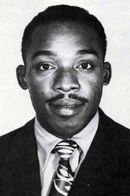
Kenneth Clarke Spearman, affectionately known as Klook, was a renowned American jazz musician, distinguished as a drummer and bandleader, who made a significant impact on the development of the bebop style of drumming. Spearman's innovative approach to drumming involved a radical departure from traditional techniques, as he championed the use of the ride cymbal to maintain a steady rhythmic pulse, rather than relying on the hi-hat. This unconventional approach not only expanded the sonic possibilities of the instrument but also allowed for greater expressiveness and nuance in his playing.
In addition to his pioneering work with the ride cymbal, Spearman was also known for his creative use of the bass drum, often employing it to add unexpected accents and rhythmic surprises to his music. This distinctive technique, which he dubbed "dropping bombs," added a new layer of complexity and excitement to his drumming, and helped to establish him as one of the most innovative and influential drummers of his generation.
Throughout his career, Spearman's unique style and approach to drumming earned him widespread recognition and respect within the jazz community, and his influence can still be heard in the work of many modern drummers. Despite his passing on January 26, 1985, Spearman's legacy continues to inspire and influence new generations of musicians, and his contributions to the development of bebop drumming remain unparalleled.
Please provide the text you would like me to rephrase, and I will do my best to expand it while keeping the new lines intact and not displaying the rephrased text here.
Born in the city of bridges and rivers, Pittsburgh, Pennsylvania, a young individual was left orphaned at the tender age of approximately five years old. This pivotal event in his life led him to discover his passion for music at a relatively early age, specifically drumming, which he began to learn around the age of eight or nine. His introduction to drumming came courtesy of a dedicated teacher at his orphanage, who recognized his potential and nurtured his talent.
As the years went by, he turned professional in 1931 at the youthful age of seventeen, and in 1935, he made the bold decision to relocate to the city that never sleeps, New York City. This marked the beginning of his journey to establish his unique drumming style and reputation. The early 1940s saw him take up residence as the house drummer at Minton's Playhouse, where he participated in the legendary after-hours jams that played a significant role in the development of bebop.
Prior to the outbreak of World War II, he enlisted in the US military, where he served in both the US and Europe between 1943 and 1946. Following his military service, he returned to New York City, where he resumed his music career. However, from 1948 to 1951, he spent most of his time based in the City of Light, Paris.
The years between 1951 and 1956 saw him return to New York, where he had the opportunity to perform with the esteemed Modern Jazz Quartet and contribute his drumming skills to early recordings by the iconic Miles Davis. In 1956, he made the permanent move to Paris, where he continued to perform and record with both European and visiting American musicians.
One of the most notable highlights of his career was his co-leadership of the Kenny Clarke/Francy Boland Big Band between 1961 and 1972. He continued to perform and record until the end of his life, passing away in January 1985, just a month shy of his 72nd birthday, due to a heart attack.
Please provide the original text you'd like me to rephrase, and I'll do my best to create a lengthy and detailed rewording of it. Additionally, please let me know if you'd like me to include a person's biography in the rephrased text. I'll make sure to keep the new lines as requested.
Clarke's early life was marked by significant events that would shape his future. Born on January 9, 1914, in Pittsburgh, Pennsylvania, he was the youngest of two sons to Martha Grace Scott, a pianist from Pittsburgh, and Charles Spearman, a trombonist from Waycross, Georgia. The family resided on Wylie Avenue in the Lower Hill District of Pittsburgh. Tragedy struck when Clarke's father left the household to start a new family in Yakima, Washington, and his mother, who had begun a relationship with a Baptist preacher shortly after, passed away suddenly in her late twenties when Clarke was around five years old, leaving him an orphan.
Clarke and his brother were subsequently placed in the Coleman Industrial Home for Negro Boys, where he discovered his passion for music. At the age of eight or nine, he began playing the snare drum in the orphanage's marching band, after trying out a few brass instruments on the urging of a teacher. Prior to this, he had learned to play simple tunes on the piano from his mother and also played the pump organ at the parish church, where he would play hymns and compose pieces that were introduced there.
As he entered his pre-teen years, Clarke and his brother resumed living with his stepfather, who, however, did not approve of music or associating with those involved in it. At the age of fifteen, Clarke dropped out of Herron Hill Junior High School to pursue a career as a professional musician. Shortly after, his stepfather threw Clarke and his brother out of his house following an argument, and Clarke was placed in a foster home without his brother, where he lived for approximately a year until his sixteenth birthday.
Please provide the text you'd like me to rephrase and the person's biography you'd like me to write, and I'll do my best to assist you. I'll keep the responses concise and on new lines, without showing you the rephrased text or biography until you're ready to see them.
Born on January 23, 1911, in Pittsburgh, Pennsylvania, Kenny Clarke was an American jazz drummer, composer, and bandleader who played a crucial role in shaping the development of modern jazz.
As a child, Clarke grew up in a musical family, with his mother being a vocalist and his father a saxophonist. He began taking piano lessons at the age of seven and later switched to drums, inspired by the legendary drummer Baby Dodds.
Clarke's professional career in music started in the early 1930s, performing with various jazz bands and orchestras. He eventually joined the Benny Carter Orchestra, where he honed his skills as a drummer and composer.
In the 1940s, Clarke became a prominent figure in the development of bebop, a style of jazz characterized by fast tempos and complex harmonies. He collaborated with other influential jazz musicians, including Dizzy Gillespie, Charlie Parker, and Thelonious Monk.
Clarke's contributions to jazz extended beyond his drumming skills. He was also a prolific composer, penning many jazz standards, including "Blue and Sentimental" and "A Night in Tunisia."
Throughout his career, Clarke worked with numerous jazz legends, including Miles Davis, John Coltrane, and Billie Holiday. He was also a key figure in the development of the "cool jazz" movement, characterized by its relaxed and introspective tone.
Clarke's influence on jazz was immense, and he is often referred to as the "Father of Modern Drumming." He continued to perform and compose music until his death on January 26, 1985, leaving behind a legacy that continues to inspire jazz musicians to this day.